


Foshan Azobina Household Products Co., Ltd. specializes in the production of sponges and related products and has a manufacturing factory in Foshan, China. We continue to grow and strive to meet users' fashion needs in the global home furnishing industry. As a well-established Chinese manufacturer and exporter, we successfully meet the needs of the global mattress home market.

Our Advantages
Rich Experience
Our team has more than 10 years of experience in the production and sales of home textile products. Azobina Fabrics and Exports has become a famous mattress manufacturer and exporter in China.
Reliable Product Quality
Our factory's facilities, technology, and performance standards are in line with international standards. We always have pre-production samples before mass production and will do a final inspection before shipment.
OEM and ODM Available
We can provide OEM and ODM services, customize logos, designs, sizes, packaging, etc. according to customer needs, and provide personalized business support.
Quick Respond to Market Needs
Low minimum order quantities and fast shipping of large quantities of in-stock products allow us to be more flexible with orders, shortening delivery times and saving our customers money.
-

Comfortable Pack And Play With A Good Memory Foam Crib Mattress For The Bassinet
Crib mattresses are typically made with specific dimensions to fit snugly within the crib frame, ensuring there are no gaps or spaces that could pose a safety risk to the baby.
Add to Inquiry -
Best Breathable Baby Mini Crib Mattress for Newborn in 24 X 38
The Mini Crib Mattress features dual firmness to provide support and comfort for babies at different stages of growth. The firm side is made of high-density support foam suitable for babies, while
Add to Inquiry -
Best Breathable Safety Foam Soft Baby Mattress for Mini Crib
This soft mini crib mattress, crafted from premium high-density foam, strikes the ideal balance, offering firm support and gentle comfort. This safety crib mattress is designed for MINI cribs to
Add to Inquiry -
Best Breathable Safe Firm Foldable Waterproof Baby Mini Crib Mattress Fit Pack and Play
Optimal Balance: Our foldable pack and play mattress topper, featuring high-density memory foam, is meticulously crafted for perfect balance.. Its soft padding adds cushion, while its breathable
Add to Inquiry -
Comfortable Pack and Play with A Good Memory Foam Crib Mattress for The Bassinet
Comfortable Pack And Play With A Good Memory Foam Crib Mattress For The BassinetSeamless Fit: Tailored to snugly fit your 38 x 26 playard, our pack and play crib mattress features rounded corners and
Add to Inquiry -
Best Portable Eco-Friendly Pure Core Mini Crib Mattress for Newborns
Restful Sleep Assurance: Our 2-Stage portable mini crib mattress, meeting Certipur-US certification standards, is hypoallergenic and crafted with high-density support foam and memory foam, ensuring
Add to Inquiry


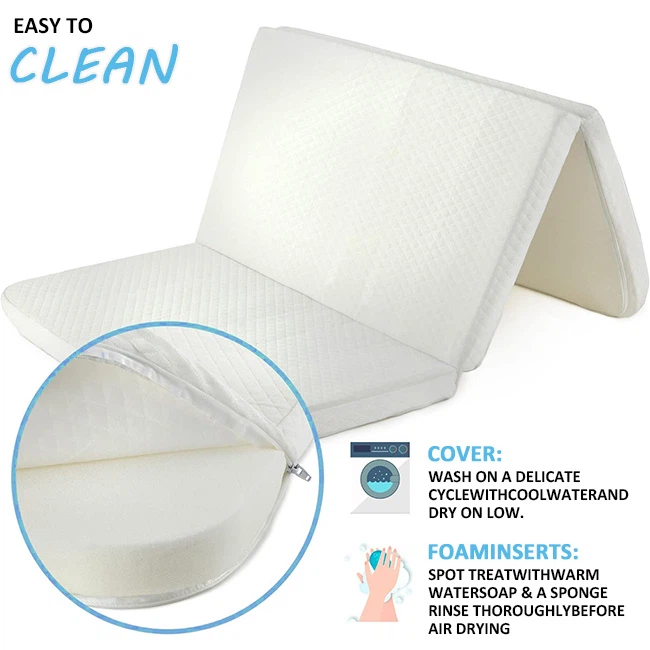
A mini crib mattress is a smaller-sized mattress designed specifically for mini cribs or portable cribs. Mini cribs are compact and space-saving alternatives to standard-sized cribs, and their mattresses are correspondingly smaller to fit the crib's dimensions.
Types of Mini Crib Mattresses
Innerspring Crib Mattress
To start, an innerspring crib mattress is a standard crib mattress with steel coils, It has an over layer of various cushioning materials. These materials include such fabrics as foam, wool, polyester, cotton, or other cellulose fibers. Lastly, this type of mattress is encased in a fabric or vinyl overlay. Consistently, innerspring mattress manufacturers differentiate themselves by describing their coil count and the steel gauge thickness of the coils. Specifically, the larger the coil count and the thicker the steel, the denser the mattress is.
- Pros of Innerspring Baby Mattresses
Innerspring mattresses are firm and create a tight fit in the crib.
- Cons of Innerspring Mattresses
Innerspring mattresses have some type of vinyl, padded, or quilted topper. Notably, innerspring mattresses have low rates of air permeability. Consequently, they have a high CO2 retention level.
Further, Innerspring mattresses require waterproofing and fireproofing chemicals. Pointing out the obvious, innerspring mattresses cannot be machine washed for disinfecting.
In addition, a mattress pad is normally used. Mattress pads also trap additional harmful CO2. Moreover, The AAP warns against their use.
Foam Baby Mattress
Next up, foam mattresses. Typically, foam mattresses are made from polyurethane. Polyurethane is a foam resin. There are different densities of foam. Also, there are different chemical makeup of the foam. Consequently, some foam mattresses will pass firmness testing, while others will not. To be sure a foam mattress is firm enough, press your hand on the mattress and see how far it sinks in. It should not sink in more than a 1/4″.
- Pros of Foam Baby Mattresses
Often, mattresses made from foam are lightweight and inexpensive. Additionally, they generally have a snug fit.
- Cons of Foam Crib Mattresses
To avoid contamination, foam mattresses have vinyl or waterproof covers. Further, they have a very low rates of air permeability – if any at all. Additionally, they retain high levels of CO2.
Since foam is a petroleum-based product, foam crib mattresses contain a fire retardant. Specifically, petroleum-based products are highly flammable. Also, if a foam mattress does not have a vinyl cover, it has some type of waterproofing chemical.
The fact is, there has to be a water barrier between the surface material and the foam. Otherwise, the foam becomes contaminated.
The vinyl surface of a foam mattress is washable. However, there is no way to wash or sanitize the foam interior. The interior is where pathogens can live.
Latex Crib Mattress
Latex mattresses are similar in construction to foam crib mattresses. Additionally, they share many of the same features. Like foam, there are different densities of latex mattresses. In spite of popular belief, pure latex does not cause allergic reactions. Most latex mattresses pass the firmness test, Additionally, latex mattresses are much heavier than foam. As a result, changing sheets can be difficult.
- Pros of Latex Baby Mattresses
Mattresses made with latex are firm. Most often, they create a nice snug fit in the crib. Additionally, they help keep a baby’s core temperature stable by eliminating the buildup of heat.
- Cons of Latex Mattresses
Latex mattresses have minimal to no air permeability. In addition, CO2 can easily build up on a latex mattress.
Most latex crib mattresses contain a fire retardant. Otherwise, they have a wool overlay. Notably, wool creates a natural fire retardant.
Moreover, mattresses made with latex use some type of waterproofing chemical to act as a water barrier. Additionally, the surface of a latex mattress is usually fabric. Being fabric, you cannot wipe it clean. Also, it is not machine washable.
Plant Based Fiber Baby Mattress
Coconut coir is the most common type of plant-based fiber used in crib mattresses. Normally, Coconut coir is used in combination with a foam or cotton layer overlay. Surprisingly, coconut coir is heavier than foam.
- Pros of Plant Based Fiber Baby Crib Mattresses
It creates a tight fit in the crib. Notably, coconut coir is moisture resistant. However, it does not do well if it gets saturated. Consequently, it needs some type of water barrier. This plant based fiber has a high level of air permeability if not mixed with other materials. Unfortunately, we could not find a mattress of this type that did not contain a mixture of other materials.
- Cons of Plant Based Fiber
A coconut coir crib mattress retains very high levels of CO2. Additionally, they require some type of vinyl covering or waterproofing chemicals. If there are no waterproofing chemicals, the coir becomes contaminated if it gets wet Also, fire retardant chemicals are used in order to be complaint with CPSC regulations.
Mini Crib Mattress Conversion Tips
When converting your crib to a toddler bed, there are a few things that will make it the safest, comfiest spot for your little one.
Follow Assembly Instructions
Above all else, follow the instructions provided by your specific crib make and model. Don’t skip over certain steps or guess at how to construct it.
Ensure You Have All the Pieces
If there are broken or missing pieces, don’t use the bed as it could be a safety hazard. You're better off finding a different crib or toddler bed.
Check to Make Sure It's Sturdy
Your toddler probably wiggles and rolls throughout the night. Make sure the frame is strong enough to hold up to toddler treatment.
Keep It Low to the Ground
Your toddler shouldn’t be far off the ground in case they fall. A lower clearance also makes it easier for them to get in and out of bed by themselves.
Secure the Side Rails
Prevent falls out of bed by making sure your model has rails, even half-rails. There shouldn’t be any gap between the rail and the side of the bed frame.
Double-Check Your Child-Proofing
In case your toddler finds their way out of bed, be sure the room is safe for them to roam. That includes covering electrical outlets, ensuring there are no small items for them to swallow and no windows they could crawl out of. If they’re tall enough to open the door, be sure any stairs are blocked with a gate. Keep medicines out of their room or up high enough so they cannot reach them.
Vacuum
Remove the mattress from the crib and shake to get rid of any obvious debris. Then vacuum the mattress thoroughly using the brush and crevice tool attachments to reach into any awkward areas. Turn the mattress over and repeat, concentrating on creases and seams.
Scrub
Mix a solution of five cups of warm water with a tablespoon of laundry detergent and use this to gently scrub the mattress to prevent damage to the fibres. Don’t over wet as this will extend the drying time, and can encourage mould.
Rinse
With clean warm water, rinse all mattress surfaces by using a damp, clean cloth and regularly wringing it out – any excess moisture should go back into the bucket. Make sure that all the detergent residue is removed as this can irritate baby skin.
Remove stains
This can be done with a homemade remedy of white vinegar, lemon juice and water. Pour the solution into the spray bottle and apply it onto the mattress. Spread small amounts of baking soda onto stubborn stains and allow this to sit for about half an hour. When the mattress feels dry vacuum thoroughly.
Disinfect
Empty the spray bottle and add rubbing alcohol and spray both sides of the mattress. This acts as a disinfectant to protect from infections, and will simply evaporate.
Dry
If the weather permits take the mattress outside to air dry in the sun. If this isn’t possible you can use paper towels or clean bathroom towels to absorb as much of the excess moisture as possible. To speed up the process you could use a portable electric fan or even a hairdryer for small damp patches.
Don’t be tempted to put the mattress back into the crib until it’s completely dry. Damp can lead to mould and mildew and can be a breeding ground for bacteria.
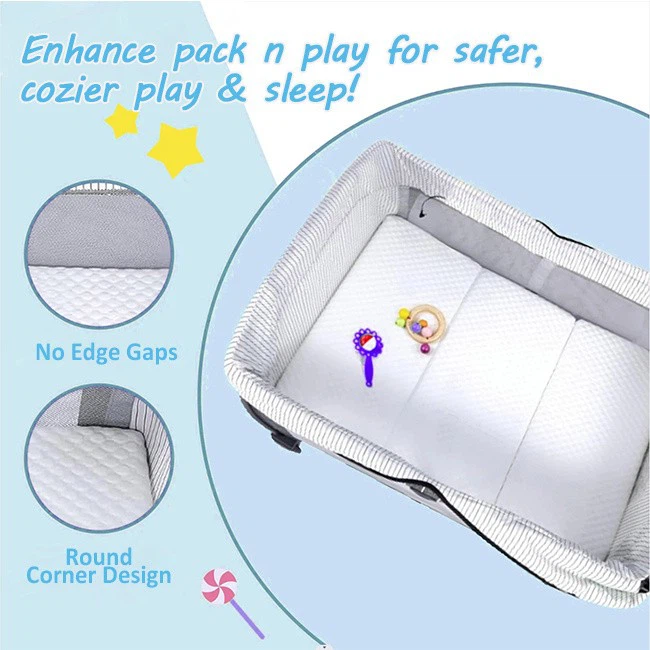
Factors to Consider Before Choosing a Mini Crib Mattress
The Right Size
Ensure that the size of the mattress complies with the recommendations on size and depth given by the crib manufacturer. The mattress size should be at least 27 ¼ x 51 ⅝ inches, and should not be more than 6 inches thick. Babies and toddlers can get their arms or legs stuck between the crib and the mattress if there are gaps. For this reason, it is crucial to make sure that the mattress fits the crib well. Check to see that there is no more than two fingers gap between the mattress and the crib. Before buying a crib mattress, be sure of the measurements of your crib and make sure that the mattress will be a snug fit with your crib.
Firmness
Is one of the most important factors to consider while buying a crib mattress. An overly soft mattress or sleeping surface can increase the baby’s risk of unexpected fatal injuries, suffocation, and SIDS, especially if an infant rolls over onto their tummy. A hard mattress can create issues with your baby’s body posture, along with making them susceptible to bad sleep cycles. Use a firm sleep surface that is compliant with standard parameters for infants and toddlers.
Important Certifications to Looking for While Buying a Crib Mattress
Many third-party organizations test and certify mattresses on a variety of parameters. Greenguard Gold is one such trusted and popular certification. If you are keen on getting a foam crib mattress, look for the certification that tests for volatile organic compounds and guarantees that the mattress is free of ozone depleters; PBDEs, TDCPP, and TCEP flame retardants; mercury, lead, and other heavy metals; formaldehyde; and phthalates.
Waterproof Covering
When it comes to babies, accidents are inevitable, so it’s essential to look for a mattress that comes with a waterproof cover or buy a good quality waterproof cover for the mattress separately. The best waterproof mattresses prevent liquids and fluids from seeping in and help provide your baby with a dry and healthy sleep environment.
Other Important Features to Look out for
● Dual-sided – Many crib mattresses are reversible and feature a firm infant side and comfortable and cushioned toddler side. If you are planning to keep the mattress for a few years, this is an important point to consider as your baby outgrows the crib and moves on to a toddler bed.
● Meet requirements for flammability – It is important that your baby’s crib mattress passes all inflammability tests. Equally important to note if the mattress is devoid of chemical-based fire retardants and has a chemical-free fire barrier.
● Crafted of hypoallergenic, non-toxic materials – Providing your baby with a healthy sleep environment is of utmost importance so pay particular attention to the materials used in the construction of a crib mattress.
Ultimate FAQ Guide to Mini Crib Mattress
As one of the leading mini crib mattress manufacturers and suppliers in China, we warmly welcome you to wholesale mini crib mattress made in China here from our factory. All customized products are with high quality and competitive price. For free sample, contact us now.
mini crib foam mattress, twin mattress good quality, pediatrician recommended crib mattress